
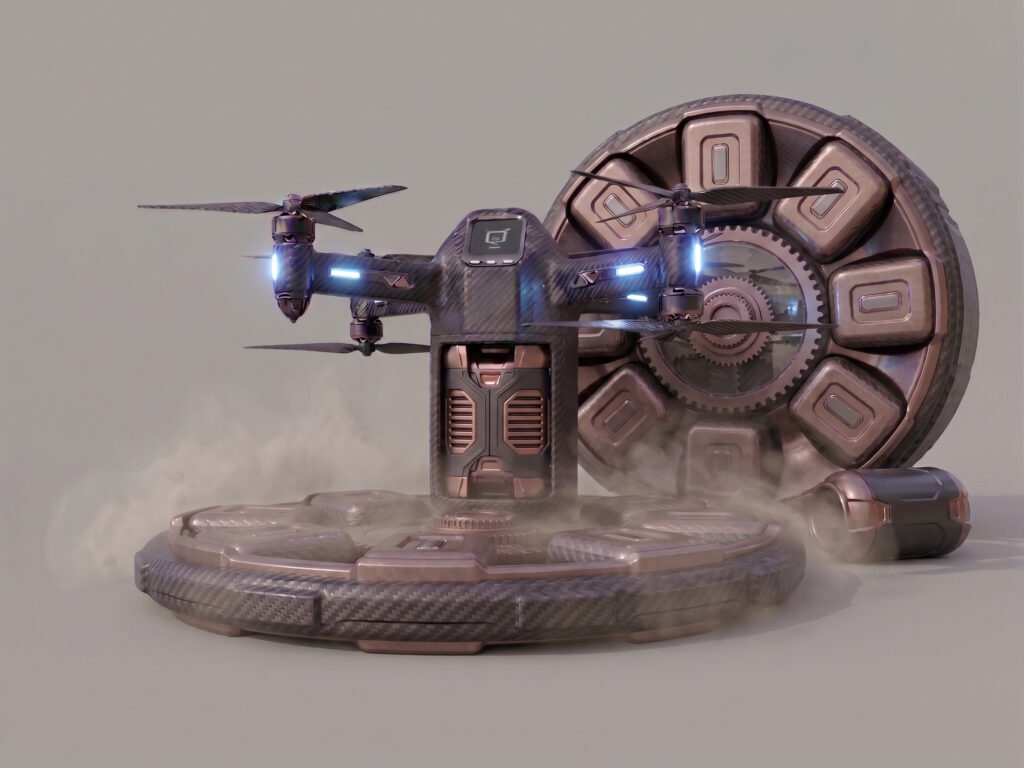
Aggregates real-time data from decentralized ground nodes, airborne UAVs, and scout drones. Visualizes the entire geographic cluster of ground stations through a single remote dashboard.
Allows a remote operator to select a specific mission payload pod from the interface. Initiates the complete physical loading and launch sequence via one “Execute” command.
Transitions immediately into a passive monitoring mode once the launch is triggered. Completely eliminates the need for active human piloting or manual tracking.
Transmits an instantaneous override signal if a sudden mission abort is required. Prompts the airborne UAV to utilize edge computing to instantly calculate a safe return vector.
Maintains systemic communication through a decentralized, ad-hoc mesh network. Enables the UAV to autonomously negotiate diversions to secondary nodes if the C2 link drops.
Environmentally sealed hub utilizes active thermal regulation. Preserves temperature-sensitive biologicals and tactical gear before flight.
Receives command and fires drive motor with heavy-duty bearings. Rotates closed-loop rotary carousel to align specific pod with aperture.
Activates localized single/dual-axis linear actuator body and internal screw. Extends vacuum-head rod to push pod into UAV internal bay.
Deploys active mechanical recovery apparatus on rubber shock mounts. Triangulates vertical/horizontal actuators along slider rails toward hovering UAV.
Grabs airframe mid-air, dampening residual kinetic energy. Connects electrical charging contacts and forces strict geometric reload alignment.
Integrates high-maneuverability quadcopters and high-speed hybrid fixed-wing aircraft. Adapts dynamically to diverse mission distance profiles and topographies.
Locks the ventrally loaded payload pod entirely within a structural holding bay. Removes external slings to completely eliminate pendular instability and parasitic drag.
Achieves unprecedented forward flight speeds due to the enclosed aerodynamic profile. Maintains strict flight stability and trajectory control in severe high-wind conditions.
Employs onboard forward and lower-facing cameras for edge-computing telemetry. Executes real-time topographical mapping to navigate effectively in GPS-denied environments.
Identifies the target autonomously for a tetherless, high-speed ventral payload ejection. Utilizes a decentralized mesh network to automatically negotiate diversions to secondary hubs during anomalies.
The returning UAV descends into a broad spatial envelope above the docking deck without relying on delicate precision-landing sensors. It transitions into a stable hover, waiting for the ground station to initiate physical contact.
A primary capture apparatus extends from the ground station along a main slider rail. Vertical and horizontal actuators articulate the rail via ball joints, moving the capture arm in a precise 3D grid to physically grab the drone mid-air.
The structural assembly utilizes rubber shock mounts to safely absorb the impact. The capture arm completely dampens the UAV’s residual kinetic energy to prevent hardware damage.
The capture apparatus immediately connects with integrated charging contact points on the airframe upon interception. This initiates battery charging the exact second the drone is secured.
The mechanical arm forces the captured airframe into a rigid, perfectly locked position. This perfectly aligns the empty internal payload bay with the loading aperture, readying the system for the next automated ventral reload.